

Amsterdam, October 19, 2026
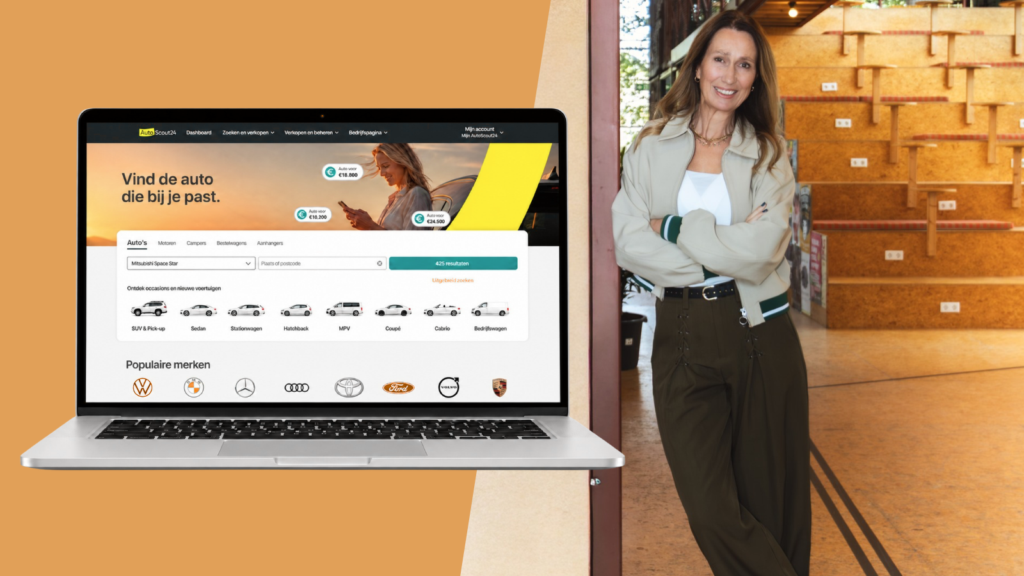
Did you want to find a used car 30 years ago? Back then, you had to rely on the print newspaper. AutoScout24 put an end to that in 2000 with a new online showroom. More than a quarter of a century later, the platform has grown into a data-driven marketing agency for car dealerships, with 30 million visitors per month worldwide.
But first, that name. Where does the “24” actually come from? It turns out to be a remnant from the early days of the internet. “Suddenly, you could search for cars day and night, and that was truly new,” says Dorianne Richelle. She has been the director of AutoScout24 in the Netherlands for five years. The website currently lists about 270,000 cars for sale. Since last November, AutoTrack (just under 224,000 cars) and Gaspedaal.nl (just under 350,000) have also joined the family. Gaspedaal.nl functions as a kind of search engine that aggregates listings from all kinds of car websites.
Waiting two weeks for a photo
Buying or selling a used car quickly and easily online. The company’s goal has never changed over the years. But the way it’s done today bears little resemblance to the early days. “Listing a car online was quite an undertaking back then,” says Richelle. “First, the photographer would visit the dealership, where each car was driven out of the showroom one by one. All the details were written down and entered into a central computer. It took two weeks for a car to go online. That was cut down to a week, then a day, and now it happens almost instantly.” Autoscout24 thus transformed the entire market. Buyers were no longer dependent on the dealership in their own town. And a car dealership with a rare sports car could suddenly showcase it to the whole of the Netherlands. And now even across the border, because Autoscout24 operates in no fewer than nineteen countries.
The User Dashboard
Whereas the platform initially focused on search filters, it’s now primarily about data. Car dealerships get a dashboard where they can see how their ads are performing and whether, for example, the quality of the photos could be improved. “A car dealership can immediately see which comparable cars are for sale within 50 or 100 kilometers, whether its price is competitive, and how long such a car stays on the lot on average. The next step is advice on purchasing. Which cars sell well and yield a good margin?”
The work of the account managers who travel across the country has also changed. “Ten years ago, it was mostly: ‘Join the platform, and we’ll take care of the leads.’ Now we sit down with the car dealership. ‘What do you have in stock, and how can we help you with that?’ A car under 15,000 euros simply attracts many more viewers than one priced over 100,000 euros. So you have to tailor the ad accordingly,” says Richelle. Data charts the course here. It’s no surprise, then, that Autoscout24 employs no fewer than 85 data scientists. Worldwide, the platform now attracts about 30 million unique visitors per month. “That data also powers the ads we place on Google, Facebook, and Instagram on behalf of car dealerships.”
Eight out of ten leave their phone number
And then, of course, there’s the rapid rise of AI. At AutoScout24, they’ve been fully committed to it for a while now. Richelle gives an example of how this technology is now generating more concrete leads. “Anyone interested in a car fills out a form that’s sent to the car dealership via email. They were asked for a phone number, but most people skipped that part. Now, while people are filling out the form, an AI assistant explains that you’ll be contacted faster if you leave your number. Suddenly, eight out of ten people are doing just that.” And together with OpenAI, the company developed a technology itcalls “companion search.” It’s already up and running in Germany, with the Netherlands set to follow soon. “Users ask a question the way they’re used to doing in ChatGPT—for example, ‘Which family car is suitable for a trip to the mountains?’ Then they seamlessly switch to the familiar filters. We thought long and hard about using a pop-up or a separate window, but that felt like two separate worlds. Now the two flow seamlessly into one another.”
The real competitor is in the United States
So, just under a year ago, there was that expansion, with the acquisition of AutoTrack and Gaspedaal.nl. Can we call that a consolidation of the market? Yes, says Richelle. “The Dutch market was quite fragmented, and these three brands complement each other well. AutoScout24 goes into depth with information, AutoTrack guides the uncertain buyer, and Gaspedaal.nl, as mentioned, has that search function.” The biggest competition now comes from the United States. Tech companies like Google, Facebook, and Amazon are following this used-car market with above-average interest. Suppose they decide to enter this arena—is AutoScout24 ready for that? Richelle has no doubts: “Of course they have deep pockets, but we offer specialization and scale. Moreover, we’re big enough to make the investments required to succeed.”